Showing posts with label Reviews. Show all posts
Showing posts with label Reviews. Show all posts
Saturday, February 28, 2015
Sunday, January 11, 2015
Friday, July 4, 2014

Friday, May 30, 2014
Sunday, March 2, 2014
Universal Men

Universal Men
Universal Men, the celebrated debut Juluka album, turns 21 this month. Richard Pithouse reports on an album that, despite being largely ignored at the time of its release, launched an inspirational career and become a national treasure.
In the mid 70’s Johnny Clegg and Sipho Mchunu started playing together as a duo under the name of Johnny and Sipho. Their infectious melodies and gentle presence didn’t disguise the fact that this union between an illiterate gardener from rural Zululand and a Jo’burg academic was as radical a musical statement as it was possible to make at the height of apartheid repression. But Johnny and Sipho were a lot more than just Verwoed’s worst nightmare. From the earliest days their music was infused with a remarkably perceptive engagement with their time and place that made it as timeless and universal as anything by Marley or Dylan.
Sipho Gumede, who was laying down bass grooves for the out-there jazz band Spirits Rejoice at the time, remembers that: “I saw Johnny and Sipho playing as a duo at the Market Cafe and I was excited by what I saw. It was the first time I’d seen a white guy playing African music and the music was very strong. We got talking and they invited us to join the recording project.”
So in 1979 Johnny and Sipho went into the studio with the country’s best musicians - people of the calibre of Sipho Gumede; Mervyn Africa, who went on to play with Jazz Africa in London; Colin Pratley from the legendary Freedom’s Children, who now runs a home for babies with AIDS in Durban and Robbie Jansen, who, of course, remains the inimitable Robbie Jansen.
Their producer, Hilton Rosenthal, had a simple plan: “to avoid commercial pressures and to give the musicians a mandate to experiment and be spontaneous. I thought we’d just put them in a room and see what came out.” The gamble paid off, spectacularly. Johnny Clegg remembers that “The most incredible aspect of the recording process was that the jazz musicians from Spirits Rejoice managed to sound completely different to their normal sound. The whole project was, musically, completely new. No one had done this before - we were flying a kite and hoping to be struck by lightning.”
Twenty one years on Sipho Gumede enthuses that “Universal Men still sounds fresh. It’s one of those albums that will be there for life. It was an innocent album. We went into the studio with the aim of making great music. No one was thinking about how many units we would sell. We just thought about the music.” Hilton Rosenthal speaks for many when he says that “There’ve been other great moments - like Asimbonanga and Scatterlings - but Universal Men is my favourite album. I have a hard time thinking about Universal Men without the hair on my neck standing up.”
The band believed, firmly, that they had produced something important but everyone in the industry told Rosenthal that it was “too black for whites and too white for blacks.” No radio station under the jurisdiction of the apartheid state would play the album so Rosenthal took it to Capital Radio in the Transkei, who played the single, Africa, to an enthusiastic but tiny listenership and to Radio Swazi where Mesh Maphetla burst in to tears when he heard Africa.
The album hit the streets late in October 1979. The sleeve carried a picture of a two men - one white and the other black. They were dressed in paisley waistcoats, beads and car tyre sandals. But they weren’t hippies. Sipho Mchunu looked into the camera with all the resoluteness of a revolutionary. Johnny Clegg gazed into the distance with a questioning intensity.
The name of the band appeared as an engraving on a gold bar. It’s shimmering glitz clashed, pointedly, with the more organic colours of the sky, the rocks, the men and their clothes. Juluka means sweat in Zulu and the message couldn’t have been clearer: Johannesburg’s wealth and glamour is built not just on gold but also on the sweat of the men, the migrant labourers, who mined that gold. But Universal Men was a world away from the abstract sterility of Marxist dogma. On the contrary it was as if the words of an African Pablo Neruda had been set to the most sublime music - a very human response to an inhuman society.
Johnny Clegg explains that “Universal Men is about bridging two worlds. Going and coming. While the worker is en route, on a bus or a train, he is given the time to look over the distances, geographic and otherwise, in his life. Migrant labourers, in Africa, Europe, everywhere, are like universal joints. They are this incredible human resource who are just sucked up by the capitalist system and used anywhere. The system makes no concessions and so the workers have to create a whole new universe of meaning.”
The album is a largely acoustic mixture of Anglophone and rural Zulu folk. Clegg’s lyrics have an extraordinary rhythm, depth and emotive power. Clegg explains that “There was so much hardness in the migrant life and yet I experienced incredibly human moments with my buddies. They lived such a rich and full life with a highly developed sense of humour and understanding of human nature. For me there was something magical and mystical in this bleak life and I felt that I needed another language to capture it and to humanize the suffering.”
Clegg was reading John Berger’s A Seventh Man, a book about migrant labour in Europe, while the album was being composed. Berger’s book influenced the album in terms of both content and style. The lyrics are often a little otherworldly, or perhaps old fashioned, and tend to focus on archetypal aspects of themes like home, loss, family, desire and work and the weight of time, distance and history. The result is that the lives described are, as in the lives witnessed in Berger’s book, removed from the detail and messiness of the now and given an eternal or universal dimension.
The album opens with Sky People. The title refers directly to the amaZulu - the people of the sky (iZulu). One man’s story rolls, like a wave on the ocean, across the larger story of his people - their past and their hopes for the future. He asks:
Where did the time, time, time go ?
My old eyes can hardly see the green fields leaving me behind
I worked the earth and turned the blade with a strong heart and steady hand
Seasons wheeled across the sky
I turned around and found that I was old
Trembling heart body cold
Wind and rain take their toll
The album was recorded just months before Zimbabwe won its independence and Clegg remembers that “there was a huge fight in the studio. “I wanted to use the line ‘The drums of Zimbabwe speak / They roll across the great divide’ but everyone was convinced that would lead to the album being banned so we eventually changed it to “The drums of Zambezi speak.” But the next lines remained:
Smiling spear with teeth of white
Give me strength to face the Night
Ancient Song Bless My Life
See me through to see the morning light.
Many of the themes introduced on Sky People were developed further on later albums and this is also true of the second track, Universal Men. Clegg explains that the title track is the pivot on which the whole album turns. It pays respect to the workers with whose sweat prosperity was built:
From their hands leap the buildings
From their shoulders bridges fall
And they stand astride the mountains and they pull out all the gold
The songs of their fathers raise strange cities to the sky
The chorus, with it nod to Neruda, is a meditation on separation and home coming.
I have undone this distance so many time before
That it seems as if this life of mine is trapped between two shores
As the little ones grow older on the station platform
I shall undo this distance just once more
My brother and my sisters have been scattered in the wind
Dressed in cheap horizons which have never quite fitted
And for centuries they’ve traveled on that pale phantom ship
Sailing for that shore which has no other shore
For a while the vision seems bleak.
The rivers of their homelands murmur in their dreams
They’re shackled to that distance till heaven lets them in
But then Clegg finds a way to affirm the resilience of hope.
Well they could not read
and they could not write
and they could not spell their names
But they took this world in both hands and they changed it all the same
And from whence they came and where they went nobody knows or cares
Cast adrift between two worlds they could still be heard to sing
The third song, Thula ‘Mtanami (Hush My Child), has all the evocative power of an archetypal lullaby. It is beautifully sung by Sipho Mchunu and was included on the album because, according to Clegg, “Sipho knew that his wife would be singing it to their child back home.” One can’t help but wonder if migrant workers don’t also sing lullabies to parts of themselves.
Deliwe, the fourth track, was overlooked for years but it was taken to a large new audience when it featured on the carefully put together Putumayo compilation, A Johnny Clegg and Juluka Collection. It has recently been worked into the Juluka set list and many now rate it as their favourite Juluka song. It’s the only song on the album which doesn’t deal directly with the migrant labourer experience but it is part of the broader theme of movement and separation in that it is about a person, Deliwe, deciding whether or not to leave South Africa. It warns that not all waters wash us on the inside and that, in a foreign land, Deliwe will be haunted by the melodies of Africa and, eventually, judged by the north winds (a metaphor for the winds of change sweeping down from the north). The song’s simple prayer has haunted more than a few expatriate South Africans and persuaded just as many to return home and live in hope:
Oh, Bless this water
Bless this land
Give us food to eat
Let our herds span the hills
Let them graze in peace
If soldiers march across our fields give them eyes to see
The children singing in the sand
Songs in the north wind
The next song, Unkosibomvu (The Red King), begins with a sound that is somewhere between Malombo and Amampondo, and develops a slightly ominous tone - as though there’s danger beneath the surface. Clegg explains that it deals with the martial psyche which is able to generate enormous power but also has a dark side. The Red King refers to “a romantic iconography of a mythological bloody king whose ability to force his will on others is admired.”
Africa, which was Capital Radio’s first ever number No. 1, remains a live favourite. Its sing-along chorus, means, in translation, “in Africa the innocent are always weeping.” Clegg describes it as a cryptic song which refers to the strong rural belief that good is limited while evil is pervasive and so the good suffer while the bad prosper.
Uthando Luphelile (Love has Gone), the 7th track, has a much harder edge than anything else on the album and, musically, it anticipates the Juluka inspired African rock movement of the late 80’s led by bands like Via Afrika and éVoid. The lyrics have a tight, edgy, urban feel. Clegg describes it as “a very weird song” and explains that “I was trying to look at the problem of prostitution at the migrant hostels - at the power of the slick city girls and to make the point that bourgeois men are also trapped by the same illusions about fantasy women.” The song warns that once you’ve “seen her in the disco club busting out all over” she
….infiltrates your desire and makes you open wide
She walks down the convolutions of your cerebellum
And tickles the right hemisphere with an electric tongue
...You will persround her like a fly”
but “you will never get to hold that woman because she’s a phantom in your mind.”
Old Eyes is a moving song about homecoming. Clegg explains that, for the migrant labourer “home coming is everything - you’re carrying presents and it’s the moment when you reveal yourself to your community as a successful person. You become a source of abundance; it’s an elevated and life giving moment in the migrant universe. There is redemption. All the degradation and alienation which you’ve endured is redeemed and transformed into a hugely meaningful event when you arrive home.
But in this song, the longed for redemption is out of reach - shattered between the anvil and hammer of apartheid. The returning worker finds that he is the “only one to witness my homecoming” and reflects that:
When I left that mountain land so gold and green
I was a sturdy 16 years
The work was hard and the wage was low
And the seasons past me by one by one
And I dreamed Maria you would wait for my return
We’d build a home upon the rock beneath the smiling sun
He finds an old man who remembers from his youth who tells him that:
Son I’ll be old until I die now
And then I will join our people in the sky
I am not the one to ask why our people have been scatted in the wind
You’ve got old eyes - amehlo madala - you’ve seen much too much for one so young
The album ends with Inkunzi Ayihlabi Ngokumisa which is a reworking of an ancient war song sung by Mchunu and adapted to the evocative sounds of the Clegg’s mouthbow. The title refers to a traditional idiomatic expression which means, in translation, “A bull doesn’t stab by means of the way in which its horns have grown.” It’s a beautiful piece of music and the gentle, meditative interpretation speaks of a softness - an openness to new ways of being. It was an inspired way to end the album.
Universal Men sold only 4 000 copies when it was first released. But two years later radio stations on both sides of apartheid’s colour line gave in to a ground swell of popular demand and allowed Impi, off the second Juluka album, African Litany, to become a massive hit. As Hilton Rosenthal remembers, rather ruefully, “Universal Men was suddenly the great first album.” It soon went gold and has never stopped selling.
Part of the magic of Universal Men is that it was the start of a brilliant career for Juluka. Each of their increasingly militant 6 studio albums, with their stories of hope and struggle, is a coherent and powerful statement. There’s not a single song that doesn’t remain a captivating listening experience. It’s a remarkable achievement.
With the exception of the incandescent Heat, Dust and Dreams none of the Savuka albums were as artistically potent as the Juluka albums. The lyrics were always well crafted, intelligent and important and there were fragments of transcendent insight. But the records tended to sound like collections of songs rather than thematically focussed artistic projects and their use of the pop sounds of the time give them a slightly ephemeral feel. The Savuka period did produce one magnificent song though - Asimbonanga: a soaring tribute to the then imprisoned Nelson Mandela. It was on the first ever Savuka release, a 4 track ep, and soon took its place with Mannenberg and Weeping as one of the great entries in our national songbook. But the poppier Savuka material did win major international success which, in turn, won the band; their vision of transcendence; and their back catalogue; major respect in white South Africa. Such are the sad ironies of colonial culture.
Juluka reformed in the late 90’s and released the forgettable Ya Vuka Inkunzi in 1997 which was later rerelesed as Crocodile Love. They are set to release another album shortly and are still, through their live performances, a vital force in South African culture. Clegg and Mchunu are still passionate people and may well make great music again. Perhaps, as with Bruce Springsteen’s Ghost of Tom Joad, they may reinvent themselves by returning to their acoustic roots and record another album with the gentle potency of Universal Men.
The world has changed a lot in the last 21 years but lives are still shattered by the machinations of inhuman forces. A new vision of resilience and hope from Juluka would be entirely welcome.
*Sipho Mchunu was not available to be interviewed for this article as he was on holiday in Paris at the time of writing.
First published: October 2000, Mail&Guardian

Thursday, February 13, 2014

Sunday, July 14, 2013
Wednesday, September 5, 2012
Veertien Monoloë Deur Skarminkels, Losers En Idiote

Krueger, Anton and; Pillay, Pravasan. 2010. Shaggy – 14 rather amusing rambles.
Pretoria: BK Publishing. 131 p. Price: R135,00. ISBN: 978-0-620-50458-4.
Resensent:
M.L. Crous
Nelson Mandela Metropolitan University Port Elizabeth
Tradisioneel is ‟n shaggy dog story ‟n besonder langdradige relaas vol kenmerkende irrelevante insidente en die slot grens dikwels aan die absurde. Dit is wat die skrywers van hierdie veertien monoloë probeer nadoen, maar dis opvallend dat hulle stories kort en soms op die man af is. Hulle hou doelbewus nie by die oorspronklike pa-troon nie.
Die outeurs spot met die akademie, lewer kommentaar op uitbuiters en manipuleerders en soos wafferse nasate van Horatius en Juve-nalis val hulle bepaalde swakhede in die samelewing aan. Die spre-kers in die monoloë is figure wat ‟n mens in die alledaagse raakloop: die afgeleefde akademikus, die uitbuiterkunstenaar, die grapjas, ‟n eertydse satanis en die skottelgoedwasser-cum-taikoen wat die spot dryf met die Kambodjaanse bevrydingstryd en soos ‟n wafferse see-rower Jenny in besit is van verskeie besighede in Margate. Margate in Natal en Germiston aan die Rand speel ‟n sentrale rol. Margate spog selfs met sy eie M.I.T.
Soos dit ‟n satirikus betaam, dra die skrywers ook deeglike kennis van die konteks wat betref dit wat hulle bespotlik wil voorstel. “The Beans” handel byvoorbeeld oor iemand wat ‟n bemarkingsvergade-ring toespreek en dan die beeld van ‟n blikkie bone gebruik om sy punt oor te dra. Uit sy reaksie op die onsinnighede wat die groep kwytraak, lei ‟n mens af dat alles op dowe ore val en hy sluit sy voorstelling met ‟n kragwoord af.
Deurgaans word ook met eietydse studente se verwysingsraamwerk gespot. Hulle kan assosieer met popkultuur en is dikwels in staat om die belangrikste literatuurteoretiese begrippe uit te spu, maar tot meer as dit is hulle nie in staat nie. Ook feministiese herskrywings en herlesings van byvoorbeeld die geskiedenis word onder die loep geneem. In “The Director” word ‟n Jamie Uys-gedenklesing gelewer en spot die spreker heerlik met die Suid-Afrikaanse filmbedryf met sy toilethumor.
‟n Satirikus is nie altyd te eksplisiet nie. Hy spot deur middel van die taal, deur middel van ironie en deur onderspeling en ‟n mate van oordrywing. Soos met alle goeie satires is dit belangrik dat ‟n mens dit in lewende lywe sien afspeel. Om Nataniël of tannie Evita op papier te lees, is nie naastenby so snaaks soos om hulle op die verhoog te sien nie. Myns insiens is dit ook die geval met hierdie “nogal amusante” stories – die subtiele humor ten spyt.
Thursday, November 17, 2011
Review of The Edge of Things, in Wordsetc

The Edge of Things, then, is an enticing title and a flexible one too, stretching to cover all manner of brinks. Characters cross the endlessly fascinating boundary between innocence and experience, naivety and self-knowledge, one sharing his first kiss at the company picnic, another beheading her first chicken.
What would infidelity look like? one story wonders, while another shows us what looks like cheating but turns out, in the flick of a needle, to be bridal branding instead. Worlds collide: matter-of-fact house renovations clang against soul-exchanges in one story while in another an empty house invites a range of intruders, from teenage lovers to lowering-the-tone buyers to symbolic creatures, recalling District 9, that challenge notions of inside and out.
Liesl Jobson’s “tips for super pics” apply with wit and pain to parent-child relationships, tracing shifts that the photographer protagonist catches out of the corner of her eye while her lens is trained elsewhere. Beatrice Lamwaka writes about a schoolgirl who wants to win a race on sports day. She has, after all, trained hard, fleeing rebel soldiers who abducted her. “I outran them so that’s an A+ for me. If anyone needs more practice in athletics, I’m sure it’s not me.”
Sometimes, an edge is sharp enough to draw blood. Then there’s literary edginess, fun with texts, intertextuality. Iconoclasm (“I don’t like Coetzee”) meets homage, for example, in Jeanne Hromnik’s exploration of new-South-African father figures both lecherous and pathetic. Perd Booysen amuses himself, and us too, with the device of the discovered journal, inadmissible as historical evidence because of its fictional finesse.
In David wa Maahlamela’s playful bus ride across the fiction/non-fiction frontier, we meet both Wordsetc and its editor, Phakama Mbonambi. In the optimistic view of the narrator, also called David, writers who describe lived experience “know exactly the impression they are intending to give their readers”. But this is perilous terrain for less adept scribes.
An event that bit your heart for real needs just as much construction on the page as a situation you make up from scratch. You can’t refer to that day, you must weave it, as Bernard Levinson does in “Tokai”. We have no idea whether the story draws on his life or his imagination or some alchemical meld of the two. What matters is that he shapes place, time and action so fully, so deftly that, like the narrator, we are moved by the mysterious intensity of the last scene.
The Edge of Things is in every sense a mixed bag. Alongside Levinson’s story, gems include Salafranca’s unforgettable image of a mother in an iron lung and Pravasan Pillay’s characters, dialogue and spicy small-canvas family drama.
Silke Heiss’s “Don’t Take Me for Free”, arguably Best in Show, nimbly outstrips our expectations. Like its trucker-clown narrator, Vonny, the story “was built to change”.
In Vonny’s extended appeal to her lover, “All-I-Have, Azar”, the language is as elating as the ride across ostrich and canola country in a bright-eyed van “with its massive, roaring heart and load continuing to doer ’n gone”.
The collection’s subtitle – South African short fiction – proposes that we read the stories as a kind of national sampler. (In a one-off slip, the introduction makes an unwarranted claim to be presenting writing “on our continent”.) Clearly, South African fiction has moved beyond the imperative to be earnest, political or even particularly South African. Mischief is now acceptable story territory, while Fred de Vries’s chilling tale could take place in almost any big city and Aryan Kaganof’s junkies claim that Amsterdam may as well be Durban, “there’s no fucking difference. Bars are the same everywhere. Drugs are the same everywhere.” But it is also true that, as per Hromnik, “the past is hungry”.
Several stories tackle a mix of race and privilege, either head-on or obliquely. In “Telephoning the Enemy”, for instance, Hans Pienaar crosses the “what if ?” line for an intriguing revisit of apartheid-era violence.
Solitude, as Salafranca notes in the introduction, features in many of the stories. We glimpse various anxious, closed, self-referential worlds. A man sits at a café table in the last story, telling himself consoling untruths and inking “NARCISSIST” into his crossword puzzle as he fends off contact.
What feels like a limitation, though, looking back over the collection, is neither inner landscapes nor low spirits (excellent fiction fodder) but rather a sense of stasis in some of the stories, a single note struck and held, Act 1 from curtain up to curtain down.
For these writers and for all the rest of us, Jenna Mervis’s story offers advice. Her protagonist “mentions nothing of … the fingernails of trees that have begun to tear at her corrugated roof in the night”. She looks for “a sign that … that the dangers outside have become manifest”. But by the end (and this won’t spoil it for you), she steps off the edge of the deck and plunges into the veld. Why not, writers? Instead of tamping down tension, why not let it explode? Approach the edge. Plunge. Leap.
REVIEWER: A Zimbabwean filmmaker and writer, Annie Holmes has published short stories in the US and Zimbabwe and a short memoir, Good Red, in Canada. She co-edited, with Peter Orner, Hope Deferred: Narratives of Zimbabwean Lives.
(Published in Wordsetc, Third Quarter 2011)
Thursday, November 3, 2011
Acerbic, merciless and funny
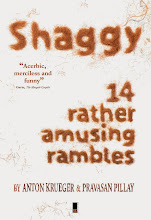
The Rhodes Drama lecturer has written three books recently: Experiments in Freedom- issues of identity in new South African Drama, for which he was awarded the Vice-Chancellor’s Book Award 2011; a poetry anthology called Everyday Anomalies; and Shaggy, a collection of ramblings/monologues he co-wrote with Pravasan Pillay.
The latter was launched at NELM’s Eastern Star Gallery recently, producing chuckles and a fair amount of squirming as Krueger’s deliberately banal brand of humour was shared with the gathering.
Prominent local poet, Harry Owen, who introduced the book, revealed how it was written in a remarkable way after Pillay and Krueger struck up an online friendship a few years ago. Finding that their shared a subversive brand of black humour, they decided to co-write what they call “fourteen stories written by creeps, losers and an idiot”.
The two have only met face to face on a few occasions yet their writing seamlessly melds into a distinctive and indistinguishable style. As Owen noted, one doesn’t know who wrote what. One of these ramblings, 'The Actress', came about when Krueger sent Pillay an article about a vacuous actress expressing her regret that her twin babies couldn’t share in her elation for an award she has yet to receive. Pillay is currently based in Sweden.
Shaggy was launched in Pretoria and Cape Town earlier this year, where some of the pieces were performed by professional actors. Owen describes the effect of reading it as “hilarious but uncomfortable; you squirm in your seat, asking yourself, could I be that one?”
Deliciously subversive and filled with bathos, almost everyone and everything is raked over the coals; from self-important academics to delusional community leaders; parodying the many idiocies of South African life. “He puts a pin into pomposity, ego and ignorance... deflates self-delusions, but does it lightly, with a smile” says Owen. He likened the seemingly pointless humour to Monty Python, Alan Bennet (Adding: “now that’s a compliment!”) and Ken Kesey’s One flew over the Cuckoo’s Nest .“Biting, cutting commentary, acerbic, merciless but above all, funny,” he concluded.
Krueger then read 'The Activist'. It is told from the rather warped perspective of the ‘leader’ of the Margate University Communist Society, who chastises fellow members for not forgoing their cell phones and continually updating their Facebook statuses.
It soon becomes a jumbled ride into the mind of a down-and-out, power hungry, washed-out student, who puts his foot into it by inadvertently revealing his own admiration for high status jobs and fat salaries, coupled with an (un)healthy penchant for Grand Theft Auto. Packed with gems such as: “Suggestions for lectures entitled ‘Revolutionising 24-hour clock time’ and ‘Why poor people have less money,’” Krueger had the audience guffawing with laughter, concluding the banal and absurd diatribe with the immensely ironic “...now that’s enough laissez-faire discussion for one meeting!”
by Anna-Karien Otto
20 September 2011
First published on the Rhodes University website.
Wednesday, October 26, 2011
Linda Stenman on Shaggy

After reading a couple of texts, you notice that you begin every new chapter with thinking, "no, not another one!". Loser, that is. Let's face it - the characters in this book impress no one but themselves. But it makes a funny book. My favourites are "The Actress" and "The Foreword" (I'm a huge fan of footnotes). My rating is four stars for some of the stories, and three for others.
I say: ***(**)
First published on Linda Loves Books
Thursday, October 20, 2011
Eclectic mix of local short stories, by Janet van Eeden

The editor of this eclectic collection of short stories, Arja Salafranca, sifted through over 100 submissions before she chose stories from the cream of South African writers. There was no theme as such, but it seems as if the stories chosen examine people who are in extreme situations,emotionally or physically.
For example, Arja Salafranca’s moving story about a woman forced to live in a restrictive apparatus in “Iron Lung” is a million miles away stylistically from Aryan Kaganof’s tale of decadence and debauchery on a night out in Durban in “Same Difference.” What is similar, though, is both stories deal with someone in extremis. The narrator of Kaganof's story is the edge of the emotional abyss. The young woman watching her mother in "Iron Lung" is too. There is no easy way to contemplate a happy future when someone you love is crippled in this way.
There are many gems in this sparkling collection. The enjoyment comes not only from the juxtaposition of many different writers, but also from reading stories with such a variety of subjects.
For example, Liesl Jobson’s “You Pay for The View: Twenty Tips for Super Pics” is a series of verbal snapshots of pivotal moments of a mother trying to find a connection with her children. It is written with poignancy and deep longing. “Doubt” by Gillian Schutte is a study of how passion can seep out of a marriage once the chase is over and when feelings of irrelevance grow due to being part of a couple.
Jenna Mervis’s “The Edge of Things” explores paranormal paranoia in a tangible way and examines the valid fear women feel on a daily basis.
The eternal clash with “the other” is explored in Gail Dendy’s “The Intruders”. Perd Booysen’s “Sinners and Sinkholes” is a delightful modern-day Hermann Charles Bosmanesque tale of ghost towns and gullibility in the arid wasteland of the Karoo.
There are too many stories to mention individually, and some
lend themselves to rereading many times. This is the beauty of the
colection: there is something to appeal to all astes. And, fortunately,
the real star of The Edge of Things is the genre of the short story itself.
(Published in The Witness, October 12, 2011)
Thursday, September 1, 2011

Wednesday, August 3, 2011
Shaggy: Side-splitting South African Short Stories

Review by Jonathan Amid
Title: Shaggy: 14 Rather Amusing Rambles
Author: Anton Krueger and Pravasan Pillay
Publisher: BK Publishing, Pretoria
ISBN: 9780620504584
In a country beset by crime, political sideshows, service delivery protests and escalating electricity prices there doesn’t always seem to be too much to laugh about, let alone the kind of laughter that makes your abdominal muscles (that you didn’t know existed) contract and contort and your cheeks start to tickle with tears of joy. Into this seeming void step Anton Krueger and Pravasan Pillay, who have just released their first collection of 14 short stories, entitled Shaggy: 14 Rather Amusing Rambles. The title in itself did not prepare me one bit for the riotous, rollicking “rambles” I was about to encounter, nor did it give any real hint of its completely overblown yet often scintillating mix of razor-sharp wit, a dry-as-dust tone and a willingness to engage the reader on an intellectual level.
What Krueger and Pillay set out to do with Shaggy is completely explode the conventions and form of the traditional shaggy-dog tale, with its usual long-winded narration and anti-climactic punchline mutated here into 14 short, sharp, seriously funny monologues set forth from the mouths of a motley crew of “scheming misanthropes whose speeches are full of sound and fury, signifying very little”.
Among this “rogues gallery” we find “manipulative, ingratiating, deluded, egotistical, inauthentic, spiteful narcissists” that all operate in Margate of all places, letting loose outlandish, eccentric and mercifully short spurts of highly imaginative verbal defecation. Some of the most memorable and ridiculous characters (often megalomaniacal and mischievous) are an SABC executive that spins a hilarious web of codswallop around the financial woes of the enterprise; a Picasso-wannabe conceptual artist that extols the virtues of the culinary as well as the corporeal; a brilliantly sketched film director of fatuous fluff who sees himself as an avant-garde auteur completely misunderstood by the censors; a Cambodian woman both compulsive and obsessive about washing dishes, despite her ownership of cosmetics empire Khmer Rouge with its arch rivals Ku Klux Glam (LOL!); and a completely ludicrous Satanist hell-bent on selling timeshare.
To say that these short stories present a shaggy and scraggly collection of characters that do little but “talk shit” would be to sell Krueger and Pillay’s work short. Through the “rambles” of these characters the authors devilishly deconstruct the quotidian and mundane, leaving the reader with little desire to breathe before the next over-the-top tale. Not a single story is without tremendously fine humour, a feather-light touch and a rib-tickling turn of phrase. If variety is the spice of life then humour is surely not far behind, and with this cracking collection Krueger and Pillay have established themselves as a brave new voice deserving of an appreciative audience.
First published on Litnet.
Thursday, July 28, 2011
A Review of The Edge of Things by Gwen Podbrey

The short story has come back into its own over the past few years, possibly because time-strapped readers find them easier to manage than a lengthy novel.
This collection includes contributions from a remarkably diverse range of writers, including Gail Dendy, Jenna Mervis, Gillian Schutte and Jayne Bauling.
If there is one central theme to the book, it is alienation (or, to use real name, loneliness). The stories capture encounters and experiences which tilt us over into the cracks between the crevices of contemporary life: those dark, uncharted spaces where needs are failed by niceties, and pain and perdition walk hand in hand.
Pick of the crop – by a long way – is Bernard Levinson’s superb “Tokai”, which recounts his delivery of an Afrikaans couple, the Bezuidenhout’s, baby in the dead of night. But the birth is complicated and the womb goes into violent contractions, forcing him to manually secure it and staunch its gushing of blood.
For hours he sits, his hand in the uterus of his semi-comatose patient, feeling this incubator of life convulse, enfold his fingers and relay to him its arcana.
“There was a slight shift of tempo. I listened with the fingers of my fist. Unmistakably, I heard the womb flutter and shift itself minutely over my fist... It stretched and gripped. Stretched again and squeezed my fist firmly. I inched my hand out. A secret dialogue between my hand and the womb. My blunt fist - mute and solid. The womb excited, chattering and intimately pressing and caressing my hand.”
Witnessing the drama of this birth - like the primordial one and, indeed, all births - Kleinman Bezuidenhout is engulfed in agony as acute as his wife’s. The next morning, Levinson - preparing to leave - sees him engaged in a ritual which matches, in every detail, the intensity and power of the previous night’s crisis.
The story is an unforgettable glimpse into the soul of the healer, whose patients’ trust in him can crucify as often as it coronates, and whose brief role in their lives - as an outsider, observing and intervening, but never sharing - carries a unique loneliness.
Later, in Liesl Jobson’s “You Pay for the View: Twenty Tips for Super Pics”, we enter the alienation of a compulsive photographer unable to fully engage with her life, and attempting instead to capture its essence through her lens “because the camera never lies”.
Yet it does, for it lacks the vocabulary to capture the truth of locations and individuals, how they imbed themselves in the DNA of the soul and remain there forever, a testimony to life and loss. These are not within the province of pixel and resolution, but of another documenting medium altogether.
The third exceptional story in the collection, Pravasan Pillay’s “Mr Essop”, recounts the arrival of a seemingly kindly, placid lodger at his parents’ home. The author, still a child, notes the growing friendship between the boarder (Mr Essop) and his father - both lonely men - and their mutual pleasure at discovering the values they have in common. But when Essop suddenly shows a brutal side to his nature, shock is added to disappointment.
Aryan Kaganof’s “Same Difference” explores yet another kind of alienation: that of drug users, whose subculture and exclusion from mainstream society force them to band together, unwillingly recognising in each other kindred tortured spirits and putting on a show of bravado to conceal their desperation.
In this ugly, treacherous world, the only allegiances which matter, last as long as it takes to shoot up a crystal meth hit.
“The upstairs toilets are for blowjobs and the schnarf sessions. The outside toilets are for quick shags and schnarf sessions … Tretchikoff girls clustered on the walls and in the mirror. Looking down serenely on the useless lives of all the pastel customers. Useless, all of it. Useless.”
As the narrator ends yet another all-night session with his gang of users in the fetid, filthy basement of a nightclub, and the sun announces the break of yet another unwelcome day, he reflects: “I’m frightened. I’m lonely. Sometimes I feel close to death. But at least I scored tonight… There is no reason to stay alive. But I refuse to bribe the reaper to come and take me.”
Hans Pienaar’s contribution, Telephoning the Enemy”, makes a brave, but failed, effort to explore the alienation of white, apartheid-bound South Africans on the verge of political change. As bombs hidden in sidewalk garbage cans claim one civilian victim after another during the early 1980s, racist beliefs are heightened and the gap between terrorist and victim appears unbreachable.
Not all the stories have the gravitas or compositional skill to sustain the reader’s interest. Angelina N Sithebe’s cumbersome, melodramatic and poorly structured “Sepia”, for example, features characters who are utterly implausible, while Rosemund Handler’s “Clueless” exhumes a stale, clichéd story line: white, lonely madam coming on to a man across the colour bar, followed by a delicious explosion of eroticism and new awareness of each other as human beings. Hardly groundbreaking stuff.
Still, with 22 out of 24 stories offering piercing insights and showcasing a range of exciting writing talent, the collection is one of the best to emerge in recent years. Salafranca’s eloquent and moving foreword whet one’s appetite for the feast to come and the contributors’ profiles at the back of the book give perspective to the voices on the pages, which demand - and deserve - an audience.
(Published in SA Jewish Report, July 8, 2011)
Thursday, July 21, 2011
Kate Turkington Reviews The Edge of Things

Short stories, as any writer knows, are possibly the most difficult literary form. In the space of a few pages, the storyteller must condense the thoughts, feelings and actions of his or her characters and then come to a conclusion.
The Edge of Things (Dye Hard Press) edited by Arja Salafranca, herself an award-winning poet and short storyteller, gives us the best of contemporary South African writers. There are many themes with many twists.
The title story The Edge of Things by Jenna Mervis marries stark everyday South African reality to a wondrous fantasy. Arja’s own story The Iron Lung reminds us that imprisonment is not only physical but emotional and spiritual. The Company Christmas Party by Hamilton Wende is about that tender first love, and Mr Essop by Pravasan Pillay tells the story of a charming old Indian pensioner who rents a cottage on a friend’s property with unforeseen circumstances. The stories are dazzlingly diverse: funny, sad, thought-provoking and relevant. Keep them by your bed or in your bag for those school lift waits.
First published on Joburg.co.za
Thursday, July 14, 2011
A Review Of The Edge Of Things By Jane Rosenthal

Though they may have been somewhat neglected in recent years, there is a long tradition of short stories in South African fiction. Some of the most famous writers are Pauline Smith, Can Themba and Dan Jacobson; more recently Ivan Vladislavic, David Medalie and Zoe Wicomb spring to mind. Practitioners of this form were hard at work last year if one judges by the two collections reviewed here. As with literary awards for fiction, it's a matter of some chance as to what appears in any given year and 2010 seems to have been particularly good. Continue reading HERE.
Thursday, June 23, 2011
Thursday, July 22, 2010
Linda Stenman on Romancing the Dead
Romancing the Dead (Tearoom Books, 2009) is a short collection of prose poems. The poems are beautiful, provoking and sometimes shocking. All of them are good and some are very good.
To read Gary Cummiskey is a special experience that shouldn’t be missed! My personal favourite is the title story. And I really like the cover.
I say: ***(**)
Thank you Tearoom Books for the review copy.
First published on Linda Loves Books. Read it HERE.
To read Gary Cummiskey is a special experience that shouldn’t be missed! My personal favourite is the title story. And I really like the cover.
I say: ***(**)
Thank you Tearoom Books for the review copy.
First published on Linda Loves Books. Read it HERE.
Sunday, January 24, 2010
Robert Berold on Romancing the Dead
Gary Cummiskey's Romancing the Dead is a 20 page collection of dream fragments and images -- more prose poems than stories -- which orbit round the confused intersections of death and sex. While the content is dark, frustrated, alienated and at times shocking, the texture of the writing is innocent, straightforward and non-egotistical. I hope Cummiskey will take this direction further into longer narrative forms. Thanks to Tearoom Books for showing how attractive very short books (chapbooks) can be. From both writer and publisher -- more please!
Subscribe to:
Posts (Atom)